
The Gulf Cooperation Council (GCC) region has been a focal point of global economic interest for decades, primarily driven by its vast hydrocarbon reserves. However, the past few years have witnessed a significant shift as member states actively pursue economic diversification strategies to reduce their reliance on oil. Within this dynamic landscape, Kuwait presents a unique case study, with a distinct business climate that both shares similarities and exhibits notable differences when compared to its regional peers like the United Arab Emirates (UAE) and Saudi Arabia.
Kuwait’s economy has historically been, and remains, heavily oil-dependent. The hydrocarbon sector accounts for a substantial portion of the country’s GDP and government revenue. This reliance has provided the nation with immense wealth and a high standard of living but has also made it vulnerable to oil price fluctuations. In comparison, while oil is still crucial for all GCC states, countries like the UAE have made more substantial strides in diversifying their economies. The UAE, particularly Dubai, has successfully established itself as a regional hub for trade, tourism, logistics, and finance, with non-oil sectors contributing significantly to its GDP. Saudi Arabia, under its Vision 2030, is also undergoing a massive economic transformation, investing heavily in new sectors like tourism, entertainment, and technology.
The business environment in Kuwait is characterized by a strong public sector that employs a large majority of the national workforce. The government is the primary driver of economic activity and infrastructure development. This contrasts with the more private-sector-led growth seen in the UAE, where free zones and business-friendly regulations have attracted a large number of multinational corporations. Saudi Arabia is also actively promoting private sector participation and foreign investment as part of its economic reforms.
 A diverse group of business leaders discussing economic trends in a modern conference room in Kuwait.
Regulatory Environment and Foreign Direct Investment (FDI)
One of the key areas where Kuwait’s business climate differs from its neighbors is its regulatory environment for foreign business. Historically, Kuwait has had more restrictive foreign ownership rules compared to the UAE and, more recently, Saudi Arabia. For many years, foreign companies were generally required to have a Kuwaiti partner holding a majority stake in any local business. However, recognizing the need to attract foreign direct investment (FDI) and foster a more competitive business environment, the Kuwaiti government has taken steps to liberalize its foreign investment laws. The Kuwait Direct Investment Promotion Authority (KDIPA) was established to promote and facilitate investment in the country, offering incentives such as tax holidays and customs duty exemptions for qualifying projects.
Despite these reforms, the pace of change in Kuwait has been seen by some as slower compared to the rapid regulatory overhauls in other GCC countries. For instance, the UAE has introduced 100% foreign ownership for companies in many sectors and offers long-term residency visas for investors and professionals. Saudi Arabia has also significantly eased its foreign investment regulations and is actively courting international companies to establish their regional headquarters in the Kingdom.
The process of starting a business in Kuwait can be perceived as more bureaucratic compared to the streamlined processes in cities like Dubai or Riyadh. However, the Kuwaiti government is working on digitalizing government services and simplifying procedures to improve the ease of doing business. The country’s strategic location at the head of the Arabian Gulf and its well-developed financial sector, with a strong banking system, remain attractive features for investors looking to tap into the regional market.
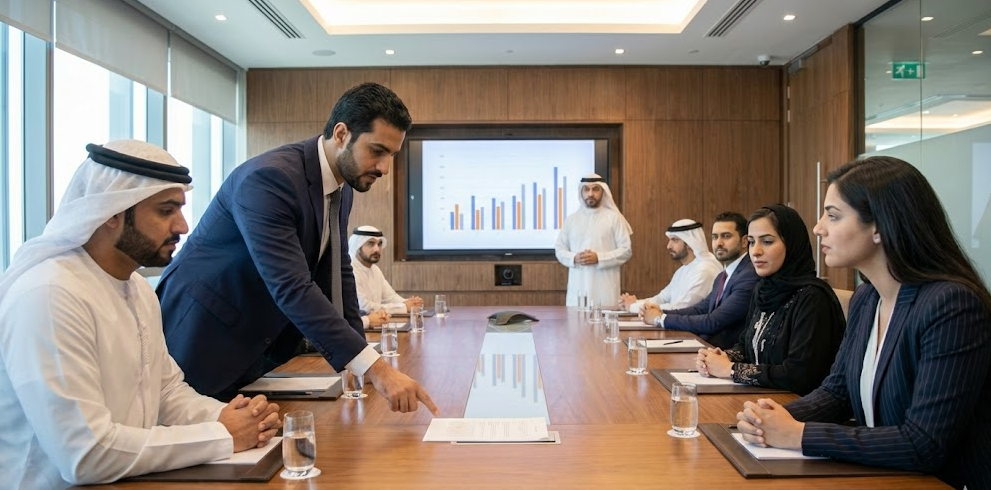 The discussion intensifies as business professionals examine a document, highlighting the collaborative nature of business in the region.
Future Outlook and Opportunities
Looking ahead, Kuwait faces both challenges and opportunities in its economic journey. The government’s “New Kuwait 2035” vision aims to transform the country into a regional financial and commercial hub, moving away from its oil dependence. Key pillars of this vision include developing a sustainable and diversified economy, improving infrastructure, and investing in human capital. The plan envisages a greater role for the private sector and foreign investors in driving economic growth.
Significant infrastructure projects are underway or planned, such as the Silk City (Madinat al-Hareer) project and the development of the northern islands, which are expected to create new business opportunities in construction, logistics, and tourism. The country is also focusing on developing its small and medium-sized enterprise (SME) sector, recognizing its potential to contribute to economic diversification and job creation.
In comparison to its GCC neighbors, Kuwait’s path to diversification may be more gradual, but it offers a stable and secure environment for business. The country’s large sovereign wealth fund, the Kuwait Investment Authority (KIA), provides a strong financial cushion and is a major global investor. The Kuwaiti market, with its high purchasing power, remains an attractive destination for consumer goods and services.
While the competitive landscape in the GCC is intensifying, with each country vying for foreign investment and talent, Kuwait’s unique position, its commitment to reform, and its long-term vision offer a promising outlook for businesses willing to navigate its evolving landscape. The key to its future success will lie in the effective implementation of its economic reforms and its ability to foster a more dynamic and innovative private sector, much like its ambitious neighbors are striving to do.
This article, Kuwait’s Business Landscape: A Comparative Look Within the GCC, is published and distributed by Arab Newswire — part of GroupWeb Media Network. To reach a target audience with press release distribution in Kuwait, the GCC/MENA region or the Arab World, please, contact us at WhatsApp or Telegram.


